REAL-LIFE MONEY LESSONS · TEENS + PARENTS

Help your teen make sense of money.

From their first paycheck to their first savings goal. Short stories and practical printable workbooks help you learn together—and put the lesson to work.

Explore the $7.99 workbook

See the three-session family guide

For ages 14–18 and their parents. No confusing jargon.

Where Did It Go? First Paycheck WorkbookLearn it. Practice it. Use it.

FREE WEBSITE LESSON · 20 SECONDS · ENGLISH

When will gas prices drop?

There is no guaranteed date. Crude-oil costs, refinery conditions, demand and taxes affect pump prices. Your local price may differ from the national average.

Try this hypothetical U.S.-dollar example: 10 gallons at $4 cost $40. At $3.50, the same 10 gallons cost $35. The 50-cent drop saves $5—not $50.

Plan the transportation money you need before deciding what is available for extras. Use the actual local price and the gallons you expect to buy.

Practice together: what if the price falls 25 cents?

For a 12-gallon purchase, $0.25 × 12 = $3 saved. Explain why the savings depend on both the price difference and the quantity—not just the number on the sign.

Hypothetical prices, not a forecast. U.S. gallons. Source checked October 4, 2026.

Source: EIA gasoline-price explanation

This gas-price lesson is free here on the website. For spending-plan practice, page 7 of Where Did It Go? helps you allocate take-home pay, including transportation. The 25-page workbook covers paychecks, spending, savings and account comparisons; it does not include a gas-price lesson or forecast.

Preview the English workbook — $7.99
START WITH THEIR FIRST PAYCHECK

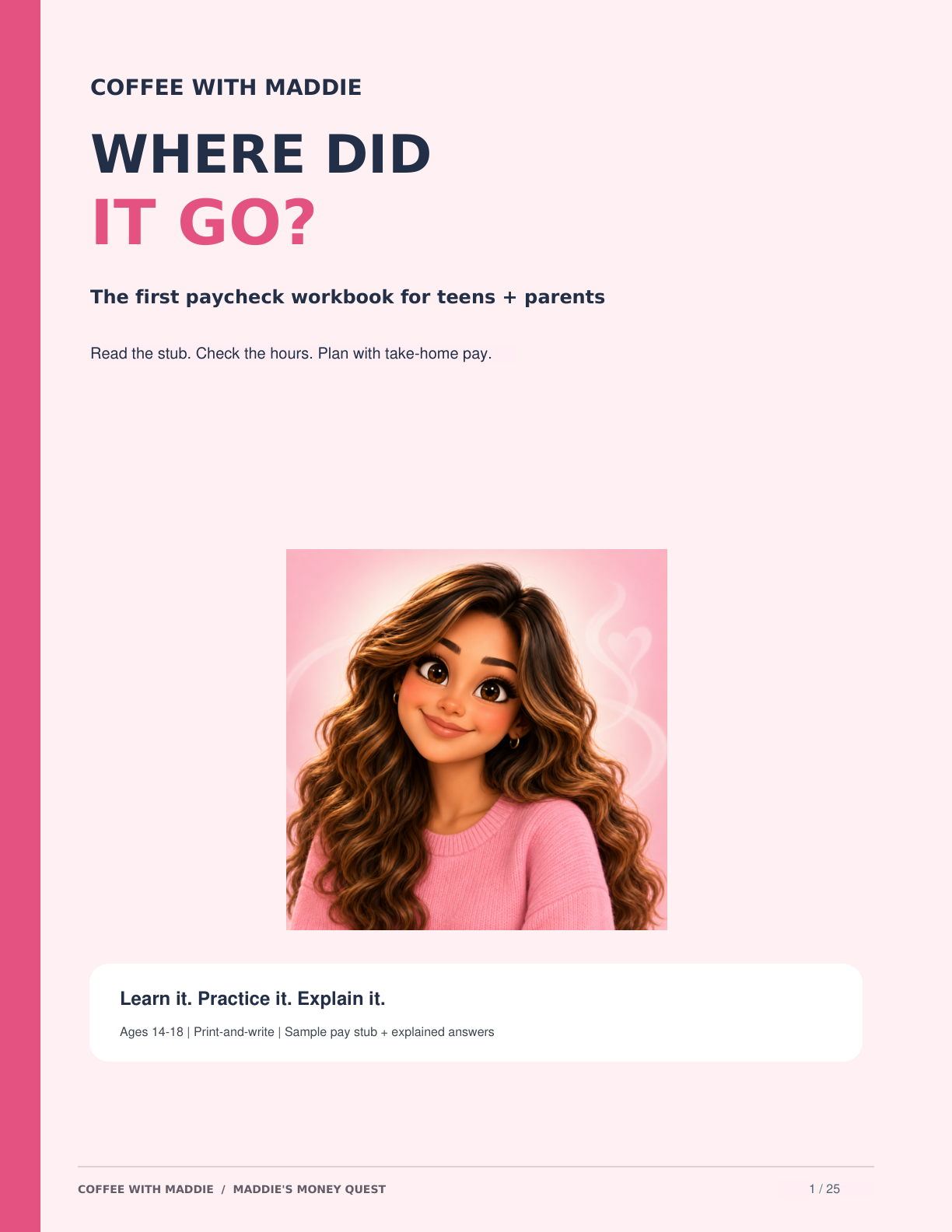
Where Did It Go?

A first-paycheck workbook that turns “Where’s my money?” into a plan.

$7.99 USD

Buy English PDF — $7.99

Comprar en español — $7.99

25 pages · English PDF · One-time purchase

Download after payment. Print and write. No physical product.

U.S. paycheck and banking examples in U.S. dollars. Account, tax and legal rules differ by country.

What you’ll learn together

01

Read a pay stub

Understand gross pay, deductions and take-home pay.

02

Check the details

Practice spotting missing hours with an example and explained answers.

03

Choose where money goes

Plan spending and savings; compare checking, savings, HYSA and CD accounts.

Preview real workbook pages

LOOK INSIDE BEFORE YOU BUY

See the exercise. Understand the answer.

Three actual pages from the 25-page workbook. Select a page to enlarge it.

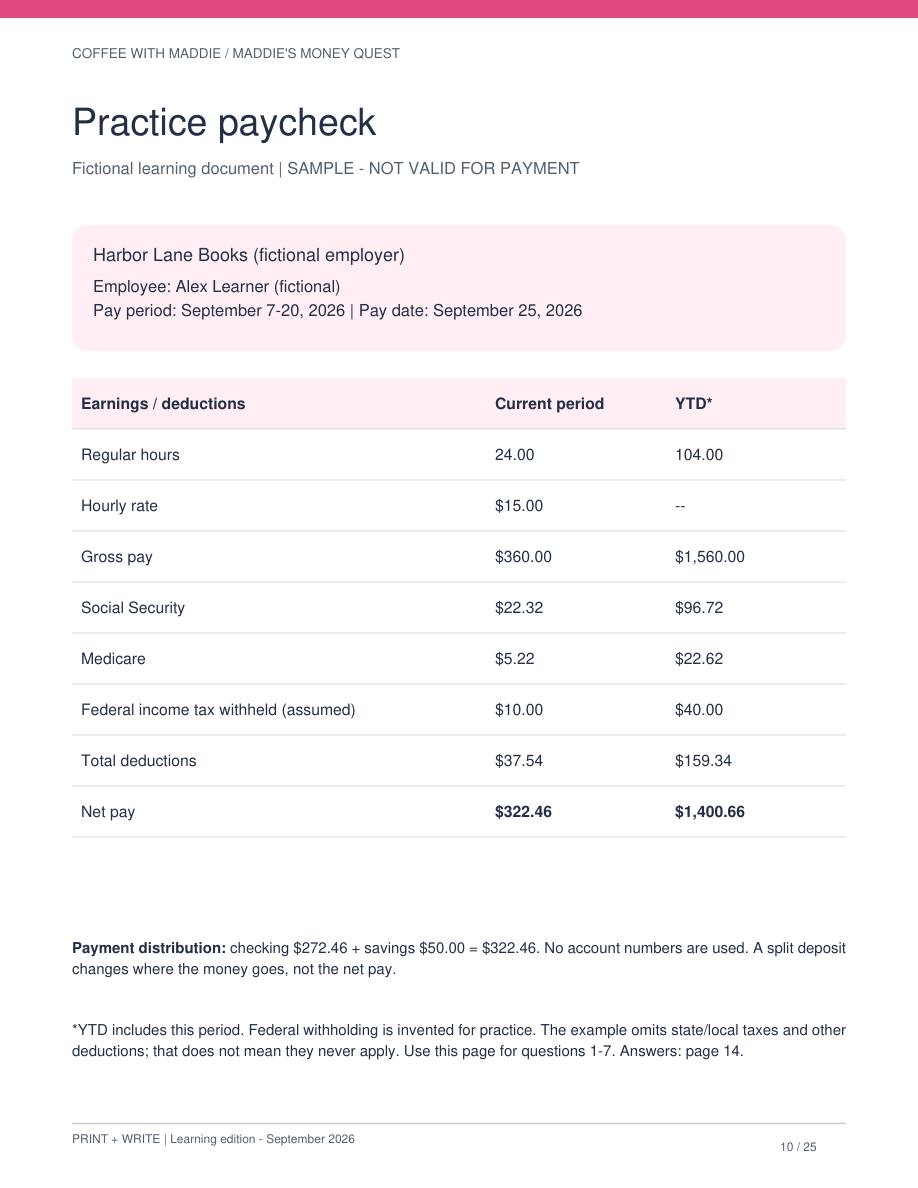
Read a fictional pay stub
Read a fictional pay stub · Page 10
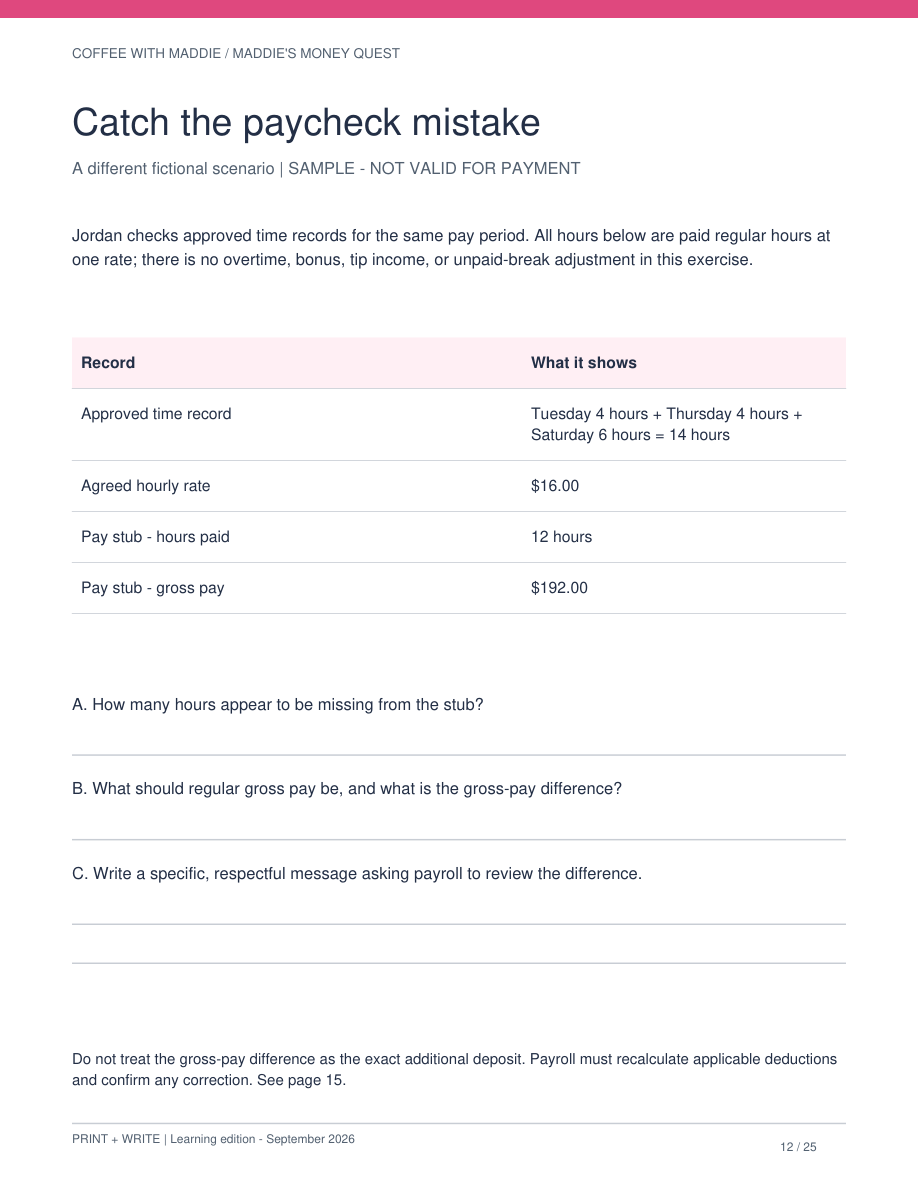
Spot missing hours
Spot missing hours · Page 12
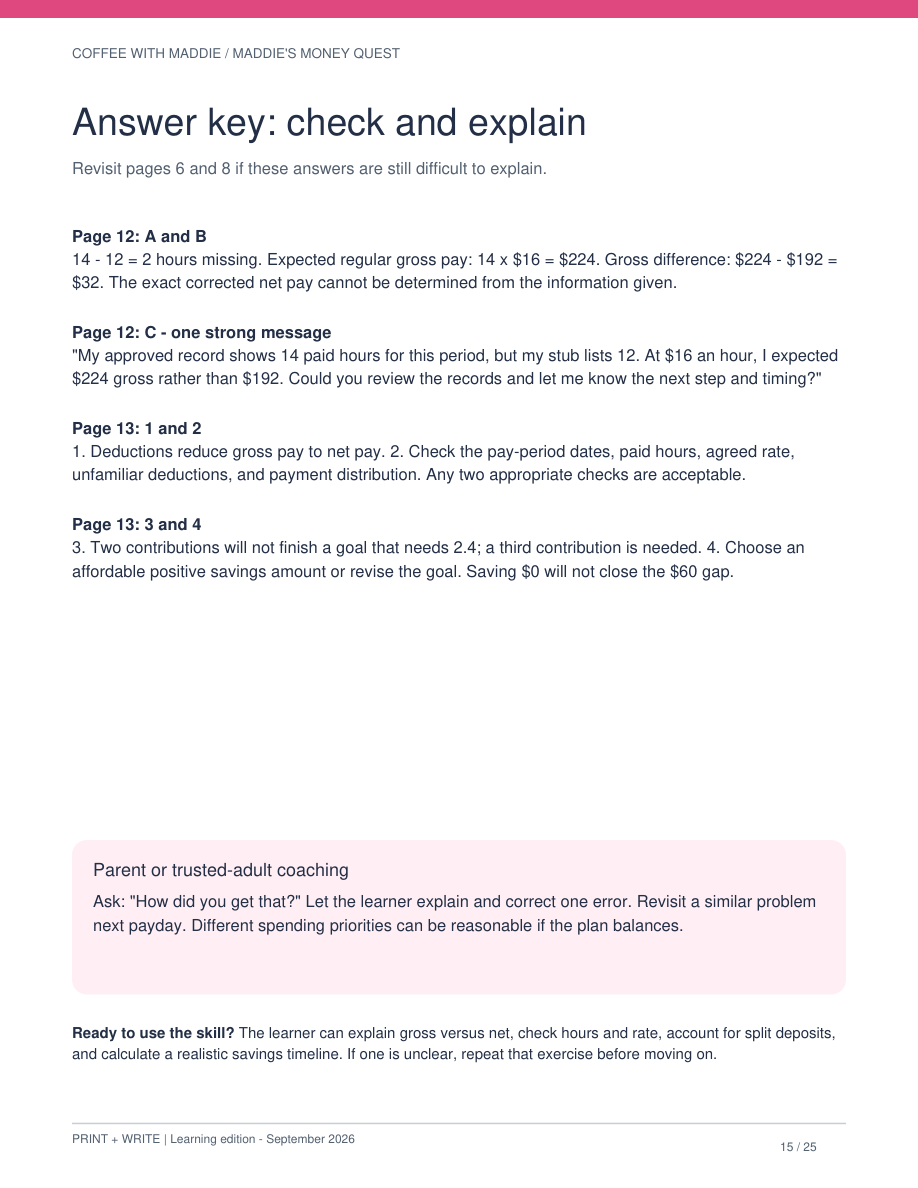
Learn why the answer is right
Learn why the answer is right · Page 15

START HERE · TEENS 14–18 + PARENTS

Three conversations. Skills you can check.

Use your 25-page workbook in three short sessions. Allow around 15–20 minutes per conversation and take longer when needed. A calculator is welcome. Your teen does not need a job yet: start with the fictional examples.

Before you start, ask “What do you think take-home pay means?” Revisit that answer after the first session. This is practice, not a test of your parenting or a formal assessment.

1. Understand one paycheck

Learn: pages 3–4 · Try: pages 10–11 · Check: page 14

Ask your teen to explain gross pay, deductions and net pay. Then check whether the deposits account for the whole paycheck.

How to check understanding

Ready to move on: they can explain why $272.46 in checking plus $50 in savings accounts for $322.46 in net pay.

If this is unclear, revisit the example together. Let your teen explain the correction in their own words before moving on.

2. Check before assuming

Try: pages 12–13 · Check: page 15 · Build the habit: pages 6 and 9

Let your teen compare hours, rate and dates, then write a respectful question to payroll. Ask “How did you get that?” before helping.

How to check understanding

Ready to move on: they can identify the two missing hours and $32 gross difference, and explain why the exact extra deposit needs payroll review.

If this is unclear, revisit the example together. Let your teen explain the correction in their own words before moving on.

3. Choose an account for a goal

Learn: pages 17–20 · Try: pages 21–22 · Check: page 23 · Plan: page 24

Compare checking, regular savings, HYSA and a CD. Name when the money is needed, how fast it can be accessed and which fees or conditions matter.

How to check understanding

Ready to move on: they can justify a choice using timing, access and fees—not only the highest APY. Record anything still to verify with the institution.

If this is unclear, revisit the example together. Let your teen explain the correction in their own words before moving on.

Finish with one next step: name what you will check on the next pay stub or account disclosure, and agree on a date to revisit it. Keep real documents private; never share account numbers or pay stubs online.

Page numbers match both current 25-page editions. General education using fictional U.S. examples in U.S. dollars. No learning or savings result is guaranteed.

Preview the workbook before buying

22 SECONDS · ENGLISH NARRATION

Earned interest. Why did the balance shrink?

A savings account can earn interest and still lose money to fees. Teach your teen to compare both.

Fictional example, one statement period: $100 starting balance + $1 interest − $5 account fee = $96 ending balance. No other transactions are included.

Ask for the fee schedule and exact waiver requirements. A student account or a different account may have lower fees; compare the actual terms.

Look inside the banking practice pages

Compare regular savings and HYSA

Read the lesson

Your savings earned interest. So why did the balance shrink? In this made-up example: one hundred dollars, plus one dollar interest, minus a five-dollar fee. Ninety-six left. Compare fees, waiver rules, and interest. Practice with our seven-ninety-nine workbook at Coffee with Maddie dot com.

ACTUAL WORKBOOK · 26-SECOND WALKTHROUGH

See how one exercise works.

Compare the hours, calculate the gross-pay difference, then check the explained answer. This walkthrough uses pages from the workbook you receive.

English narration. Both language editions are available separately.

Choose your workbook — $7.99

TRY ONE WORKBOOK EXERCISE

Can your teen spot the difference?

Jordan’s approved time record shows 14 regular hours at $16 per hour. The pay stub lists 12 hours and $192 in gross pay. What needs checking?

Fictional example from page 12. No overtime, tips, bonuses or unpaid-break adjustments.

Reveal the answer and explanation

Two hours appear to be missing. 14 × $16 = $224 expected gross pay. $224 − $192 = $32 gross difference. This is not necessarily $32 more in the bank: payroll must confirm the hours and recalculate deductions.

Ask together: Why is checking the deposit alone not enough? Compare the hours, rate and pay period too.

Keep practicing with sample paychecks, savings activities and explained answers.

Get the English workbook — $7.99

25-page print-and-write PDF. One language per purchase. Download after payment.

FREE WEBSITE LESSON · 21 SECONDS

Deleted the app. Still being charged?

Deleting an app does not cancel its subscription. Find who bills you, cancel with that provider, and save your confirmation.

Free website lesson, separate from the paid workbook. English narration.

See cancellation steps and sources

FREE WEBSITE LESSON · 24 SECONDS

Made $100. Kept how much?

A teen washes cars and earns $100. Supplies and transportation cost $35. The lesson? Money coming in is not the same as money left after expenses.

This example leaves $65 before taxes and any other expenses. Free website lesson, separate from the paid workbook. English narration.

Watch all money lessons
Read the lesson

Revenue is money coming in. Profit is revenue minus expenses. In this example: $100 − $25 for supplies − $10 for transportation = $65, before taxes and any other expenses. Plan what you keep.

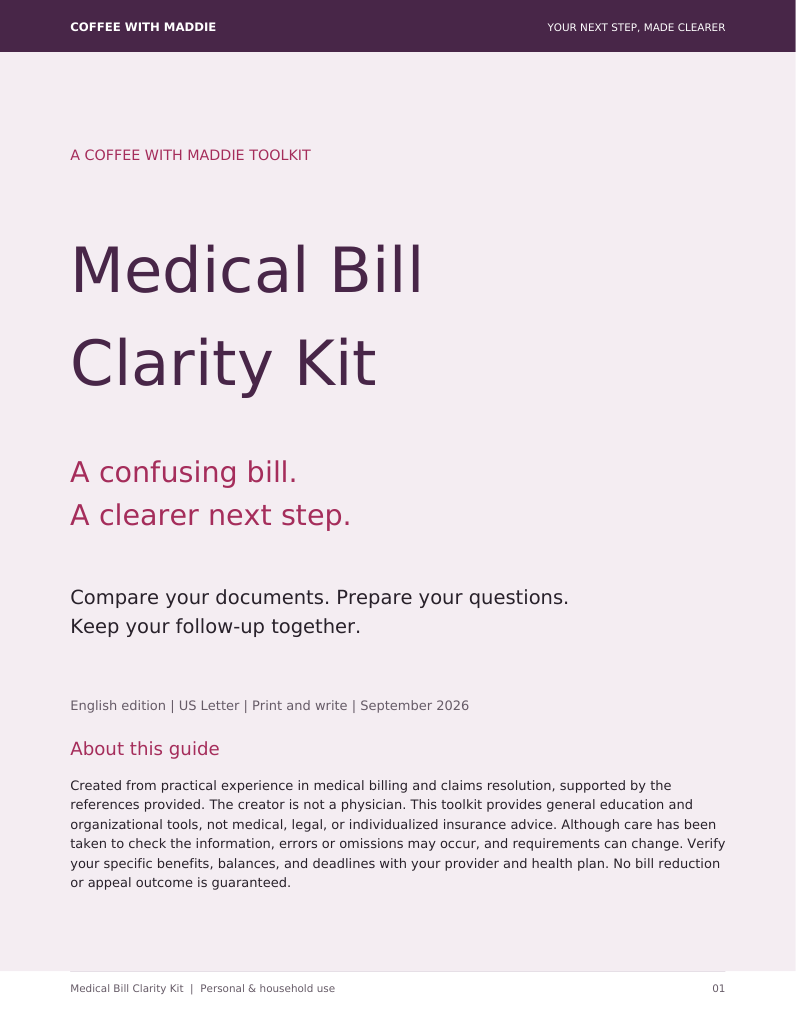
Medical Bill Clarity Kit cover

ALSO FOR YOUR FAMILY · MEDICAL BILL RESOURCES

Medical Bill Clarity Kit

Know what to compare and what to ask. Organize your bills, insurance explanations and follow-up calls with printable worksheets and six call scripts.

22 pages · English PDF · $9 USD · Digital download

Explore the $9 kit

MEET MADDIE

I’m sharing the money lessons I wish someone had taught me.

When I was growing up, nobody really taught me how to manage money. I learned many of those lessons the hard way—and some didn’t start making sense until my 30s and 40s.

I’m not perfect, and I don’t have every answer. I’m still learning, too.

I created Coffee with Maddie to help parents and teens have these conversations earlier, with practical examples and explanations that make sense. No shame about what you don’t know. Just a place to learn together and take the next step.

—Maddie

Mom, medical-billing professional, and creator of Coffee with Maddie. Based on experience and educational research. General education, not personalized financial, medical or legal advice.

Take a look inside the workbook

Before you download

Who is the workbook for?

Teens ages 14–18 and parents learning about first paychecks and everyday money decisions together.

What do I receive?

A digital PDF after payment. Where Did It Go? has 25 total pages, including the cover, instructions, activities, explained answers and references; it is not 25 separate worksheets. The Medical Bill Clarity Kit has 22 pages. Print the worksheets to complete them by hand. No physical item is shipped.

Which lessons are included in the workbook?

Both 25-page editions teach paycheck terms and checks, spending plans, savings goals, checking/savings/HYSA/CD comparisons, APY, fees and account access. They include fictional practice, explained answers and a family plan. Subscription cancellation, gas-price factors, side-hustle profit, credit cards and deferred-interest promotions are free website lessons, not workbook chapters. Investing and crypto are outside this workbook’s scope.

Are the products available in Spanish?

The teen workbook is available as separate English and Spanish editions, each $7.99. Choose the purchase button for your language; each purchase includes one language. The Medical Bill Clarity Kit currently sells in English.

Does the purchase include personal advice?

No. These are educational resources for independent use. They do not include individual consultations or guarantee financial results.

Need help with your download?

Use the download link shown after your website purchase and check your purchase email. If you bought on Etsy, use the download instructions in your Etsy receipt. Need help or want to share feedback? Send Coffee with Maddie a direct message on Instagram using the link below.