WATCH & LEARN · MIRA Y APRENDE

One money question at a time.

Start with the family guide, or choose a money question below. Each lesson shows its language. Spanish gas-price and bank-fees lessons and the Spanish family guide are available on our Spanish page.

Watch these lessons free. The separate $7.99 workbook teaches paychecks, spending plans, savings and account comparisons with exercises and explained answers. Subscription cancellation, gas-price factors, business profit, credit-card repayment and deferred interest are taught here on the website, not as chapters in that workbook.

Guía familiar y lecciones en español

START HERE · TEENS 14–18 + PARENTS

Three conversations. Skills you can check.

Use your 25-page workbook in three short sessions. Allow around 15–20 minutes per conversation and take longer when needed. A calculator is welcome. Your teen does not need a job yet: start with the fictional examples.

Before you start, ask “What do you think take-home pay means?” Revisit that answer after the first session. This is practice, not a test of your parenting or a formal assessment.

1. Understand one paycheck

Learn: pages 3–4 · Try: pages 10–11 · Check: page 14

Ask your teen to explain gross pay, deductions and net pay. Then check whether the deposits account for the whole paycheck.

How to check understanding

Ready to move on: they can explain why $272.46 in checking plus $50 in savings accounts for $322.46 in net pay.

If this is unclear, revisit the example together. Let your teen explain the correction in their own words before moving on.
2. Check before assuming

Try: pages 12–13 · Check: page 15 · Build the habit: pages 6 and 9

Let your teen compare hours, rate and dates, then write a respectful question to payroll. Ask “How did you get that?” before helping.

How to check understanding

Ready to move on: they can identify the two missing hours and $32 gross difference, and explain why the exact extra deposit needs payroll review.

If this is unclear, revisit the example together. Let your teen explain the correction in their own words before moving on.

3. Choose an account for a goal

Learn: pages 17–20 · Try: pages 21–22 · Check: page 23 · Plan: page 24

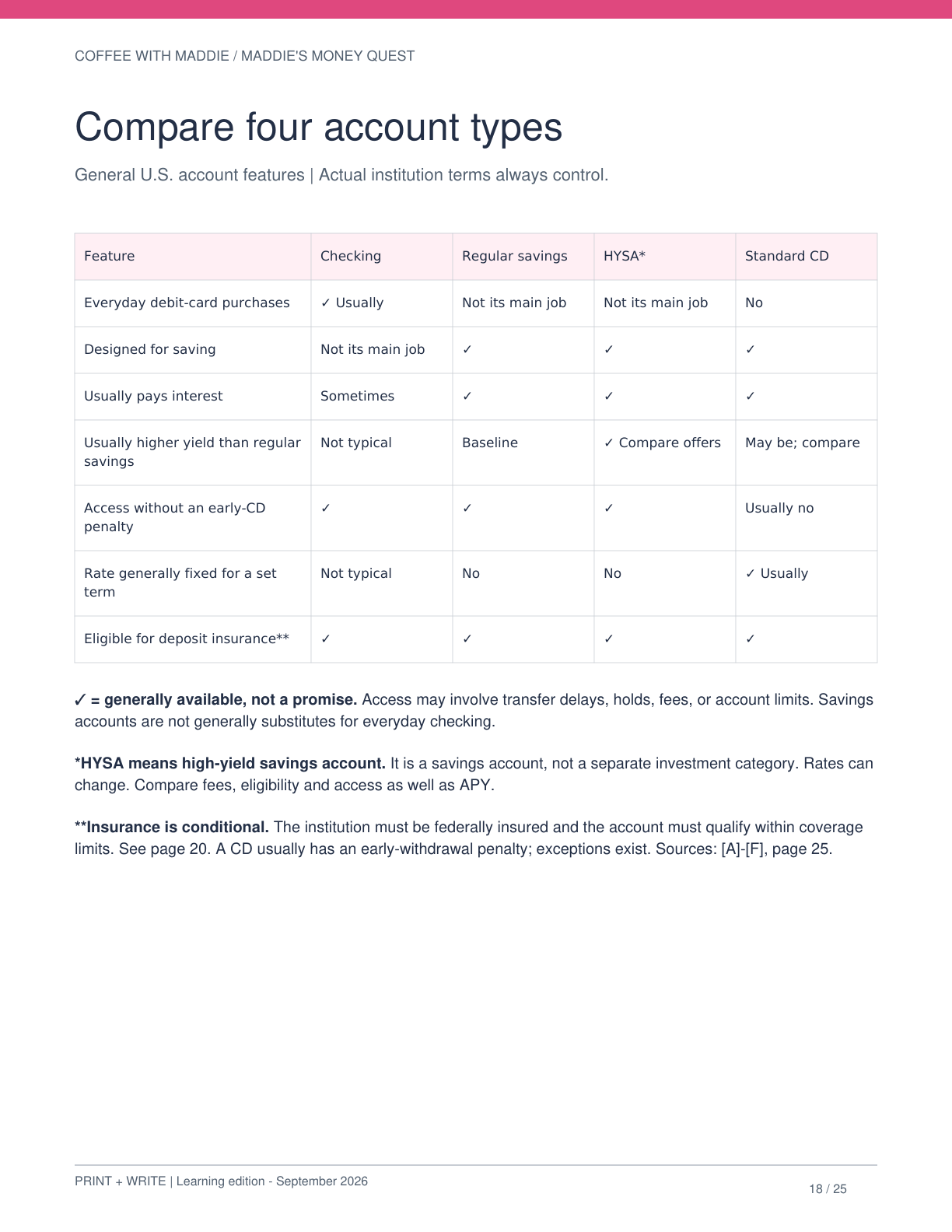
Compare checking, regular savings, HYSA and a CD. Name when the money is needed, how fast it can be accessed and which fees or conditions matter.

How to check understanding

Ready to move on: they can justify a choice using timing, access and fees—not only the highest APY. Record anything still to verify with the institution.

If this is unclear, revisit the example together. Let your teen explain the correction in their own words before moving on.
Finish with one next step: name what you will check on the next pay stub or account disclosure, and agree on a date to revisit it. Keep real documents private; never share account numbers or pay stubs online.

Page numbers match both current 25-page editions. General education using fictional U.S. examples in U.S. dollars. No learning or savings result is guaranteed.

Preview the workbook before buying

FREE WEBSITE LESSON · 20 SECONDS · ENGLISH

When will gas prices drop?

There is no guaranteed date. Crude-oil costs, refinery conditions, demand and taxes affect pump prices. Your local price may differ from the national average.

Try this hypothetical U.S.-dollar example: 10 gallons at $4 cost $40. At $3.50, the same 10 gallons cost $35. The 50-cent drop saves $5—not $50.

Plan the transportation money you need before deciding what is available for extras. Use the actual local price and the gallons you expect to buy.

Practice together: what if the price falls 25 cents?

For a 12-gallon purchase, $0.25 × 12 = $3 saved. Explain why the savings depend on both the price difference and the quantity—not just the number on the sign.

Hypothetical prices, not a forecast. U.S. gallons. Source checked October 4, 2026.

Source: EIA gasoline-price explanation

This gas-price lesson is free here on the website. For spending-plan practice, page 7 of Where Did It Go? helps you allocate take-home pay, including transportation. The 25-page workbook covers paychecks, spending, savings and account comparisons; it does not include a gas-price lesson or forecast.

Preview the English workbook — $7.99

22 SECONDS · ENGLISH NARRATION

Earned interest. Why did the balance shrink?

A savings account can earn interest and still lose money to fees. Teach your teen to compare both.

Fictional example, one statement period: $100 starting balance + $1 interest − $5 account fee = $96 ending balance. No other transactions are included.

Ask for the fee schedule and exact waiver requirements. A student account or a different account may have lower fees; compare the actual terms.

Look inside the banking practice pages

Compare regular savings and HYSA

CFPB: maintenance fees and waiver conditions

Source checked October 4, 2026. General education; account terms vary.

Read the lesson

Your savings earned interest. So why did the balance shrink? In this made-up example: one hundred dollars, plus one dollar interest, minus a five-dollar fee. Ninety-six left. Compare fees, waiver rules, and interest. Practice with our seven-ninety-nine workbook at Coffee with Maddie dot com.

ACTUAL WORKBOOK PAGES · ENGLISH EDITION

Turn the banking lesson into a family conversation.

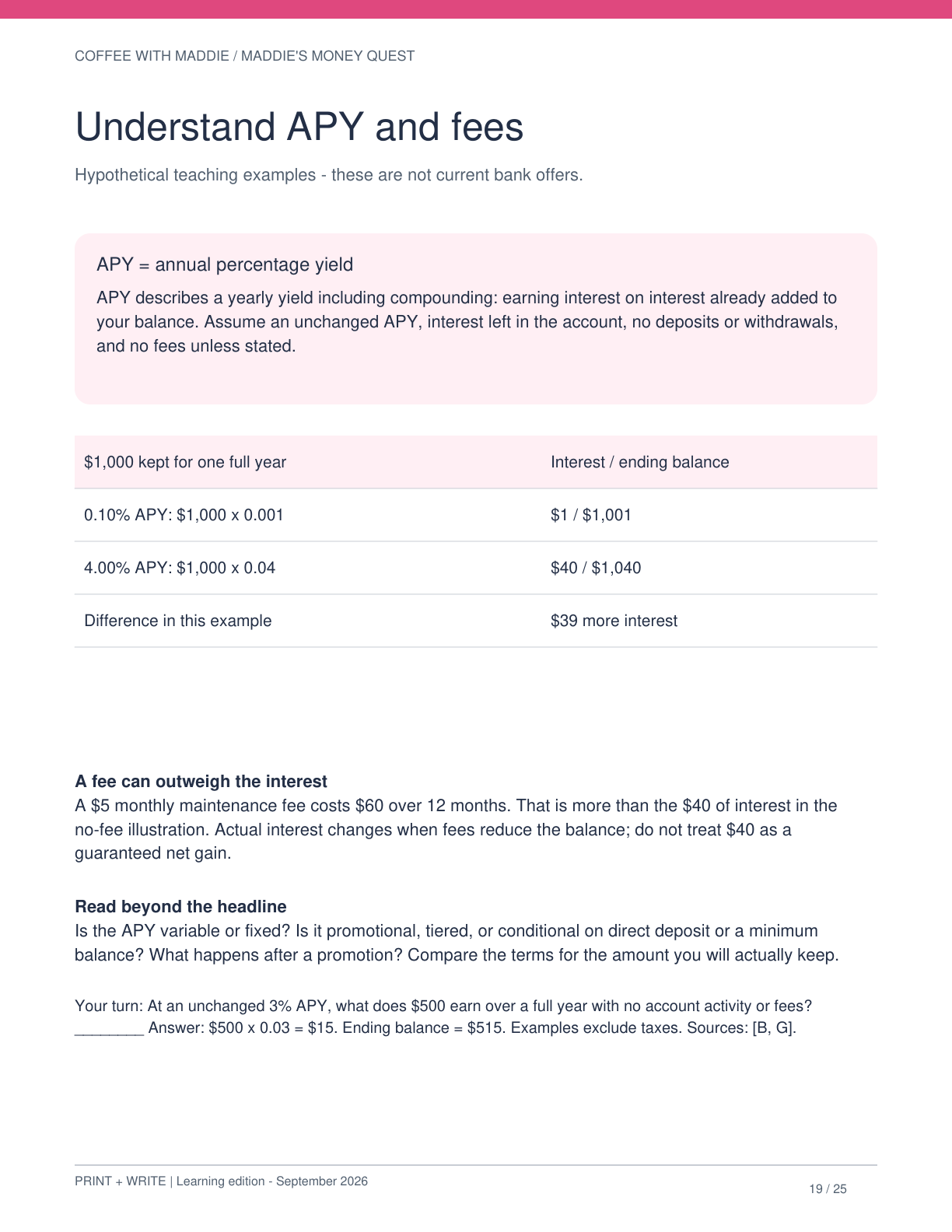
These are pages 18 and 19 from the 25-page English edition of Where Did It Go? Select a page to read it at full size.

Compare checking, regular savings, HYSA and CDs, actual English workbook page 18
Compare checking, regular savings, HYSA and CDs · Page 18
Understand APY and how fees can outweigh interest, actual English workbook page 19
Understand APY and how fees can outweigh interest · Page 19

Try the $500 example on page 19 together. Then use page 21 in the workbook to collect two real account disclosures and compare fees, rates, access and eligibility. The workbook also includes practice scenarios, explained answers and a family plan.

U.S. banking examples in U.S. dollars. Account terms and protections differ by country.

Get the English PDF — $7.99

Ver las páginas y el cuaderno en español

25 total pages, including cover, instructions and references. Print and write. One language per purchase. Digital download after payment; no physical item.

NEW LESSON · 22 SECONDS

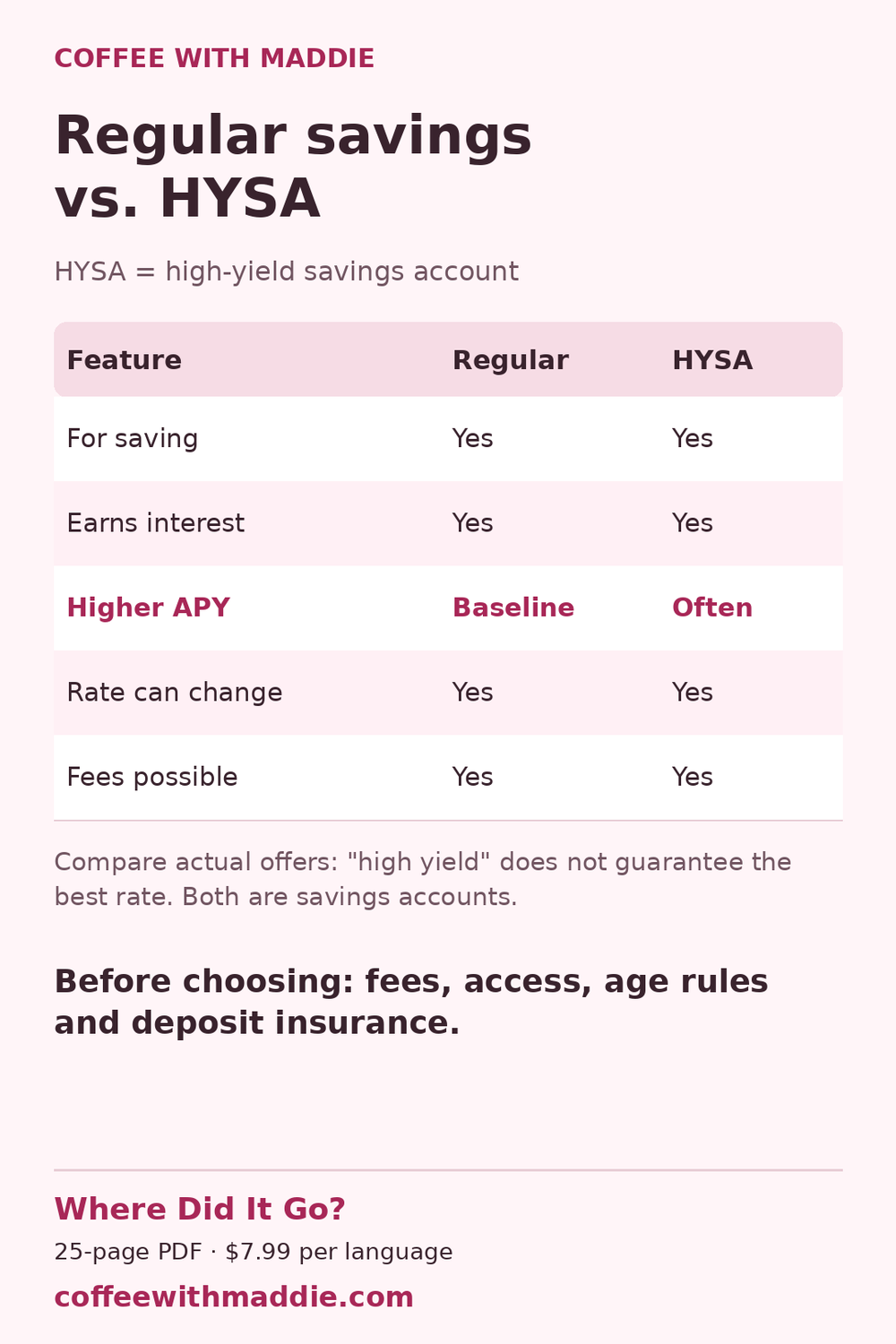
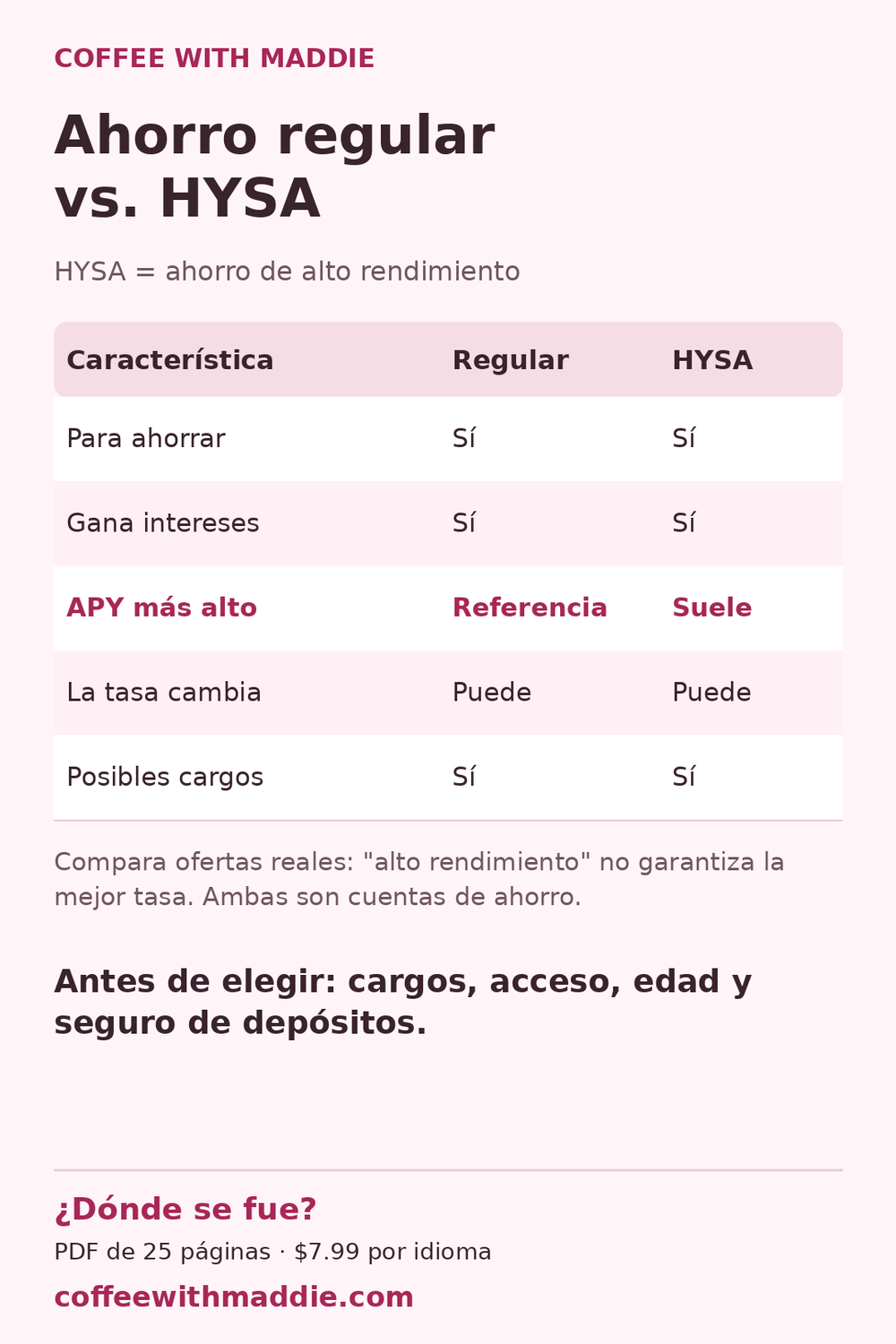
Regular savings or HYSA? Understand the difference.

An HYSA is a high-yield savings account. It often pays more interest than regular savings, but the name alone does not guarantee the best deal.

APY is annual and includes compounding. In this teaching example, $100 ends at $101 with 1% APY, or $104 with 4% APY, after one year.

Hypothetical rates, not offers. Assumes a constant rate, interest retained, no fees or other transactions, and one full year; before tax. Actual rates can change. English narration and captions.

Practice comparing accounts — $7.99
Compare before choosing an account

Check fees and waiver conditions, minimum balances, access and transfer timing, and age requirements. Minors may need an adult, depending on the provider.

For eligible deposits at an FDIC-insured U.S. bank, coverage is up to $250,000 per depositor, per insured bank, per ownership category. Same-bank deposits in the same category are combined; it is not a limit per account. Credit unions use a different insurance system.

CFPB: APY · HYSA mechanics · FDIC coverage

Sources checked October 3, 2026. General education; compare current provider terms.

Download English comparison · Descargar comparación en español

Read the lesson

An HYSA is a high-yield savings account. It often pays more interest than regular savings. With $100 left for a year, 1% APY earns $1; 4% earns $4. These are sample rates, not offers. Rates can change. Compare accounts with our workbook at coffeewithmaddie.com.

NEW LESSON · 26 SECONDS

Is $50 missing—or already in savings?

Checking is only one part of the picture. In this practice paycheck, $272.46 went to checking and $50 went straight to savings. Together, that is $322.46 in take-home pay.

Read the payment distribution before assuming money is missing. A split deposit changes where your pay goes; it does not reduce your net pay.

Fictional U.S. paycheck example in U.S. dollars · Workbook page 10 · English narration with captions.

Practice with the workbook — $7.99
Read the lesson

Your teen sees $272.46 in checking. Is $50 missing? In this practice paycheck, $50 went straight to savings. Together, that is $322.46 in take-home pay. Check the payment distribution before assuming something went wrong. Practice this together with Where Did It Go? Find the printable workbook at coffeewithmaddie.com.

FREE WEBSITE LESSON · 21 SECONDS · ENGLISH

Deleted the app. Still being charged?

Deleting an app does not cancel its subscription. Find who bills you, cancel with that provider, and save your confirmation.

Apple: Settings → your name → Subscriptions. Google Play: open your subscriptions and select the subscription to cancel. Complete all confirmation steps. If a company bills you directly, cancel with that company. Check the account you used and the end date.

Cancellation does not automatically refund earlier charges. Payment plans may have remaining payments.

Ready to practice everyday money skills together? Preview the first-paycheck workbook before buying. The workbook covers pay stubs, spending plans and savings; the cancellation instructions are here in this lesson.

Try a workbook exercise

Apple cancellation guide · Google Play cancellation guide

FREE WEBSITE LESSON · 24 SECONDS · ENGLISH

Made $100. Kept how much?

Revenue is money coming in. Subtract expenses to understand what remains. This car-wash example leaves $65 before taxes and any other expenses.

This is a free website lesson. The separate workbook teaches employee paychecks and personal spending plans; it does not include a business-profit or self-employment-tax module.

Try a free workbook exercise

Illustrative example. General financial education.

FREE WEBSITE STORY · Episode 001 • Episodio 001

Ana’s first credit card.

The first playable story follows Ana from excitement to a $600 balance—and shows why paying only the minimum is not a real payoff plan.

30–40 secEnglish + españolInteractive captioned story
COFFEE WITH MADDIEEPISODE 001 / 001
THE HOOK • EL GANCHO

Ana thought a $35 minimum payment meant she was doing everything right.

Ana pensó que pagar el mínimo de $35 significaba que lo estaba haciendo bien.

Example assumes no new purchases; actual interest and minimum-payment formulas vary by card. • Ejemplo educativo.

AI narration in English and Spanish • Narración con IA en inglés y español

Maddie’s takeaway • La lección de Maddie

The minimum payment keeps the account current, but it is not designed to eliminate debt quickly. Read the APR, pay more than the minimum when possible, and calculate your payoff date.

El pago mínimo mantiene la cuenta al día, pero no está diseñado para eliminar la deuda rápidamente. Lee el APR, paga más del mínimo cuando sea posible y calcula tu fecha de pago total.

FREE WEBSITE STORY · Episode 002 • Episodio 002

Sofia and the “0% interest” trap.

Sofia buys a $1,200 sofa under a “no interest if paid in full” promotion—and learns why the deadline and those five words matter.

1:28 EN • 2:05 ESEnglish + españolNarrated video
COFFEE WITH MADDIEEPISODE 002 • EPISODIO 002

Choose your language • Elige tu idioma

Narrated video with on-screen captions • Video narrado con subtítulos en pantalla

Maddie’s takeaway • La lección de Maddie

“No interest if paid in full” can mean deferred interest. Read the promotion terms, calculate your payoff target, and finish before the deadline.

“Sin intereses si se paga por completo” puede significar interés diferido. Lee los términos, calcula tu meta de pago y termina antes de la fecha límite.

Episode 003 • Episodio 003

The medical bill she almost paid.

Marisol pauses before paying a $430 statement, compares it with her EOB, finds a missing prior payment, and gets the account corrected to $20.

1:16 EN • 1:31 ESEnglish + españolNarrated video
COFFEE WITH MADDIEEPISODE 003 • EPISODIO 003

Choose your language • Elige tu idioma

Narrated video with synchronized captions • Video narrado con subtítulos sincronizados

Maddie’s takeaway • La lección de Maddie

Compare the provider bill with your EOB. Check the date and service, claim status, allowed amount, insurance payment, patient responsibility, and payments already made.

Compara la factura del proveedor con tu EOB. Revisa la fecha y el servicio, el estado del reclamo, el monto permitido, el pago del seguro, la responsabilidad del paciente y los pagos realizados.

Illustrative example; benefits and billing situations vary. Sources: CMS EOB guide and CMS medical-bill guide.

Episode 004 • Episodio 004

Mom, where did my first paycheck go?

A teen earns $300, sees $265.05 deposited, and asks the question every first paycheck deserves. Read the stub together, then make a plan for the money that arrived.

English + español5-part storyFor teens and parents
Where Did It Go? Coffee with Maddie workbook cover
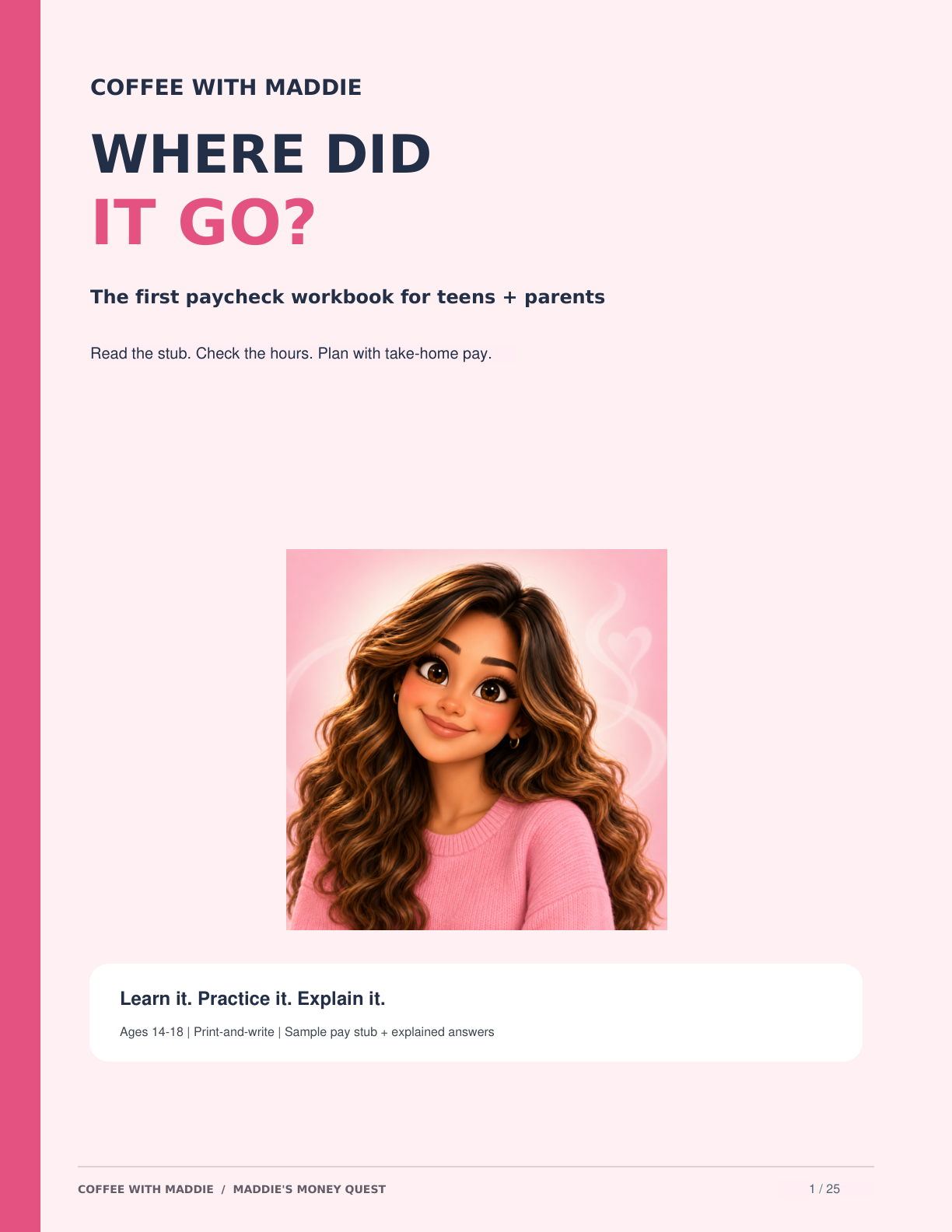
Where Did It Go?

25 printable pages with a sample pay stub, missing-hours challenge, savings worksheets, checking/savings/HYSA/CD comparison, and explained answers. Includes an account-comparison worksheet and parent–teen money plan. Print-and-write PDF. Choose one language below; each purchase includes that edition.

Buy English PDF — $7.99

Comprar PDF en español — $7.99

27-second video · English narration

Read the interactive lesson / Lee la lección
COFFEE WITH MADDIEEPISODE 004 • EPISODIO 004
Hear the story • Escucha la historia0:26 narration • Use the story cards below to follow the paycheck example.

01 / 05

Mom, where did my money go?

I worked 20 hours at $15 an hour. That should be $300.

Maddie’s takeaway • La lección de Maddie

Ask to see the pay stub, then find gross pay, each deduction, and net pay together. Overtime, tips, and multiple pay rates can change the calculation.

Illustrative U.S. paycheck example. Actual deductions depend on the worker and employer.